What you get from this page: you will be able to rank any three-card hand without a chart, follow a betting round from the boot to the show, and pick a table whose limits match what you planned to spend.
Teen Patti runs on the same skeleton as poker, just compressed into three cards. Each player holds three, the pot sits in the middle, and every turn asks the same question: pay to stay, raise the price, or fold. It is quick to learn and easy to play badly, because most first sessions are lost to two habits rather than bad luck — calling out of politeness, and forgetting what the boot has already taken from the stack.
This guide is written for players in Malaysia who will mostly play on a phone, often in short bursts. It assumes no poker background. Read the vocabulary once, skim the hand table twice, and you are ready to sit down at an electronic table without guessing.
A table you can read in ten seconds
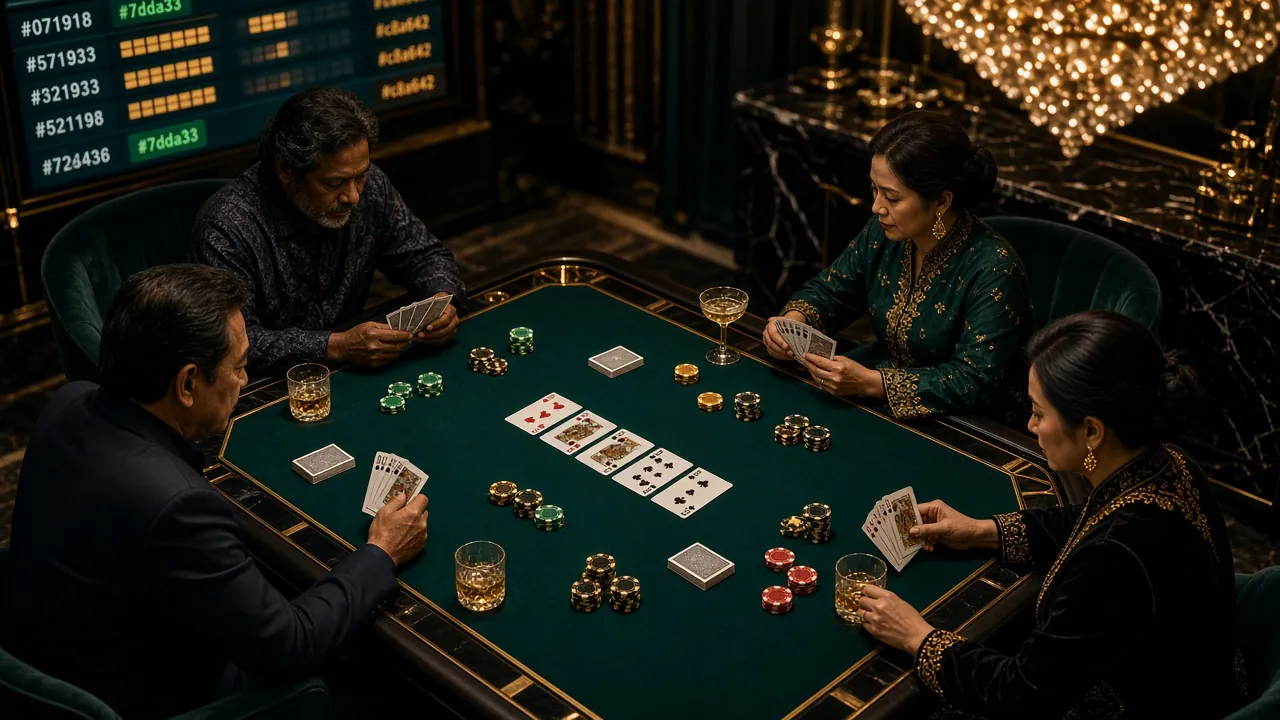
Three to six players share one pot. The dealer gives each of them three face-down cards, and everyone contributes the opening stake before a single card is turned. From there the game is a loop: match the current bet, raise it, or fold and wait for the next deal. The last two players standing compare cards, and the stronger hand takes everything in the middle.
The words are the part beginners skip, and then wonder why the buttons confuse them. Learn these six and the table stops being mysterious.
- Boot
- The opening chip every player pays before the deal. It builds the pot and it is gone from your stack either way.
- Blind
- Playing without looking at your cards. The stake is lower, the information is zero.
- Chaal
- The current bet you must match to stay in the hand. Raising it pushes the price up for everyone behind you.
- Pack
- Folding. You leave whatever is already in the pot and wait for the next deal.
- Side show
- A seen player asking another seen player to compare cards privately, outside the main showdown.
- Show
- The final comparison when only two players remain and both hands go face up.
One honest note on playing blind. It looks cheap because the blind stake is usually half the seen stake, but you are paying real money for a hand you cannot evaluate. Blind play makes sense for a round or two, to keep the table guessing. It stops making sense the moment the pot grows.
Hand ranks: what beats what, with no guessing
Six categories settle every showdown, and the order never changes between tables. Memorise it once and you will not need a chart again.
| Rank | Hand | Example | What it means |
|---|---|---|---|
| 1 | Trail (trio) | A♠ A♥ A♣ | Three cards of the same rank. Nothing beats it. |
| 2 | Pure sequence | 5♥ 6♥ 7♥ | Three running cards in one suit. |
| 3 | Sequence (run) | 9♠ 10♦ J♣ | Three running cards in mixed suits. |
| 4 | Colour (flush) | 2♠ 7♠ K♠ | Three cards of one suit that do not run. |
| 5 | Pair | 8♦ 8♠ 4♣ | Two cards of the same rank plus a kicker. |
| 6 | High card | A♠ J♦ 6♣ | Nothing connected. The top card decides. |
Two rules clear up almost every argument at a beginner table. First, a run can wrap around the bottom of the deck: A-2-3 is the lowest sequence and Q-K-A is the highest, so Q-K-A beats A-2-3 even though both hold an ace. Second, when two players share a category, compare the highest card of that category, then the next one. A pair of eights beats a pair of sevens, and 8-8-K beats 8-8-4 on the kicker.
Suit order is not part of the standard game. Some private tables rank spades above hearts to split a dead tie, and a live table will display its house rule on screen. If you are unsure, ask before the first deal rather than after a disputed pot.
Betting rounds, step by step
Every hand moves through the same five beats. The speed changes with the table; the order does not.
-
Post the boot before the deal
Each seat pays the opening stake into the pot before cards are dealt. Nothing is won here, but the pot exists before you have seen anything, which is exactly why folding early is cheaper than it feels.
-
Play the first round blind or seen
Blind players bet at the lower blind stake. Looking at your cards moves you to the seen stake, normally double. Staying blind keeps the price down, but you are paying to bet on nothing.
-
Call chaal, raise, or pack
On your turn, match the current bet, raise it, or fold. A hand that needs two perfect cards to improve is a fold. A pair, a run or three of one suit is worth one more round.
-
Ask for a side show once you are seen
A seen player may request a side show against another seen player, paying a fee to compare cards privately instead of betting on. It ends a hand without exposing your cards to the whole table.
-
Take the show when two players are left
The last raise or call forces the showdown. Both hands go face up, the stronger category takes the pot, and the next deal starts.
Tables also set a maximum stake per round, and some cap how many times a bet can be raised. Both limits are shown on the table itself. Once the cap is reached, the hand goes straight to the show, which is often good news if you are holding a strong pair.
Live dealer table or electronic one: which fits the moment
gdc99 runs both kinds, and the rules are identical in each. What changes is the rhythm, the company and the size of the minimum bet.
| Detail | Live dealer table | Electronic table |
|---|---|---|
| Cards from | A presenter dealing a physical deck on camera | Game software, with the shuffle handled by the server |
| Pace | One hand at a time, set by the table | A fresh round whenever you press play |
| Stake range | Set per table and displayed before you join | Teen Patti Joker: RM0.50 to RM500 per bet |
| Company | Chat with the presenter and the other seats | None. You play on your own |
| Works well for | A slow evening session with the shuffle visible | Short rounds on a phone between other things |
Live tables here are supplied mainly by JILI and Ezugi, and they behave like a real card room: the presenter deals, the timer runs, and you wait your turn. Electronic tables are dealt by software, so a hand can be over in under a minute and nobody is waiting on your decision. For a first session the electronic version is usually kinder, because the minimums are smaller and mistakes cost less.
Limits and RTP before you sit down
Two figures decide whether a table suits you: the minimum and maximum bet, and the return to player. Limits decide how long a budget lasts. RTP describes what the game pays back across a very long run of hands. It is not a promise about tonight, and no session should be planned around it.
| Game | Provider | RTP | Min bet | Max bet |
|---|---|---|---|---|
| Dragon of Demons | JILI | 95.3% | RM2 | RM1,000 |
| European Blackjack | JILI | 96.3% | RM2 | RM100 |
| Double Fortune | PG Soft | 95.0% | RM1 | RM1,000 |
| Treasure Hunt | JDB | 97.4% | RM1 | RM2,500 |
| Cat Fishing | JILI | 97.2% | RM0.50 | RM1,000 |
| Callbreak Quick | PG Soft | 95.2% | RM0.10 | RM2,500 |
| Teen Patti Joker | CQ9 | 96.8% | RM0.50 | RM500 |
| Circle | Ezugi | 96.3% | RM1 | RM2,500 |
Teen Patti Joker is the straightforward starting point: CQ9 software, 96.8% RTP, bets from RM0.50 up to RM500. Work out your session budget the simple way, by multiplying the minimum bet by the number of hands you expect to play and adding room for raises. If that figure feels uncomfortable before you start, the table is too big for the session.
Habits that keep a session comfortable
None of this is about winning more hands. It is about ending the session on your own terms rather than the pot's.
- Set the budget before you open the table Deposits start at RM20 and withdrawals at RM80, so both numbers are worth knowing up front. A session budget you decided before the first boot is a decision; one you decide after three losses is a reaction.
- Read the bonus terms, then decide The welcome offer adds 240% to a first deposit up to RM925, with a 15x wagering requirement attached. It is only a good deal if you were going to play that volume anyway.
- Fold more often than feels polite Nobody at the table is offended by a pack. Chasing a weak hand through three raises is the most common way a small stack disappears.
- Cash out when the plan says so Approved withdrawals land in around 43 minutes here, which makes leaving the table a real option rather than a vague intention.
- Finish verification early A National ID Card, passport or driving licence is needed before your first withdrawal, and reviews take about 24 hours. Sending documents at midnight with a pending cash-out is not the moment to discover this.
- Use the limits and take the break Deposit limits and time-outs exist for exactly the evenings when a session stops being a game. Set them while you are calm, not while you are chasing.
Questions players ask before their first hand
How much do I need for a first Teen Patti session?
Teen Patti Joker takes bets from RM0.50 to RM500, and the minimum deposit is RM20, so a small first session is perfectly workable. Live dealer tables set their own limits, shown on screen before you take a seat.
Is A-2-3 a valid sequence?
Yes. A-2-3 is the lowest run and Q-K-A is the highest. That means Q-K-A beats A-2-3 even though both contain an ace, and both beat a colour such as 2-7-K of one suit.
What happens when two players hold the same hand?
Compare the highest card of the category, then the next one. A pair of eights beats a pair of sevens, and 8-8-K beats 8-8-4 because of the kicker. If the hands are identical, the pot is split.
Can I keep playing while my documents are under review?
Yes. Verification is only required before your first withdrawal, not before you play. Upload a National ID Card, passport or driving licence and the review normally takes around 24 hours.
Is Teen Patti available in the gdc99 app?
It is. The APK is free, version 3.9.18, 52 MB, and runs on Android 9.0 and above. Get the app here if you would rather play on a phone than in a browser tab.